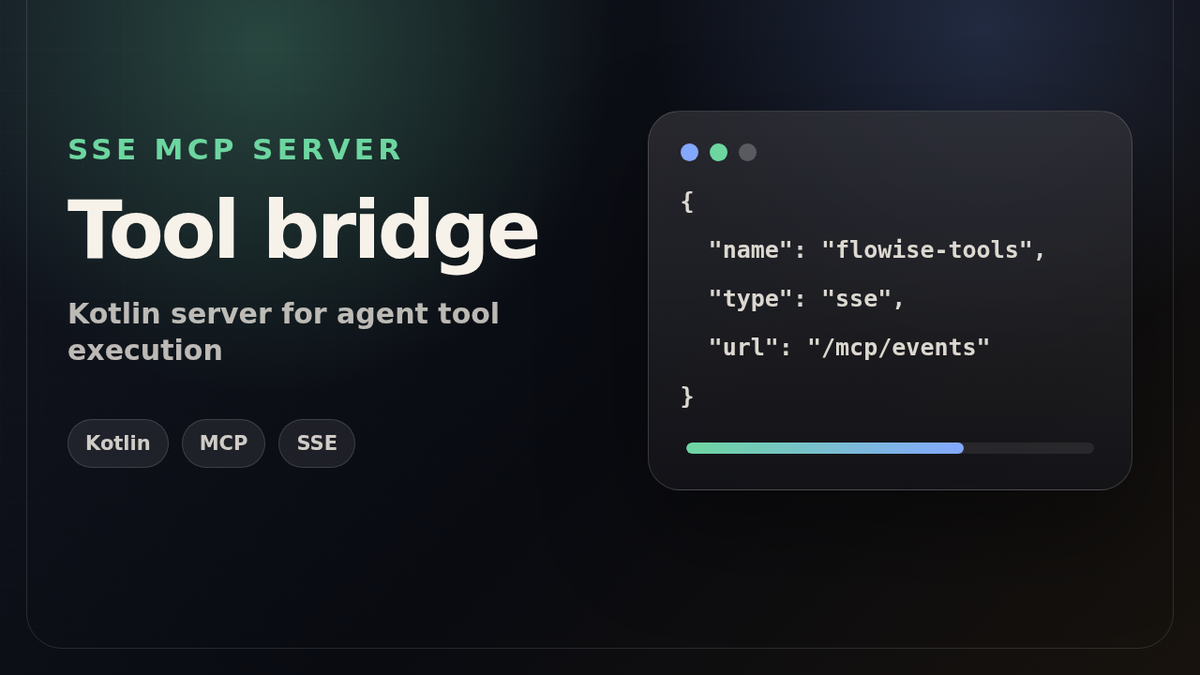
Spring Boot Kotlin MCP bridge for exposing backend tools to Flowise-style agents over Server-Sent Events. It makes tool execution inspectable: the transport is explicit, tools are registered through provider interfaces, and the agent connects through a concrete SSE endpoint instead of a hidden adapter layer.
The problem
Agent builders often reach for a visual workflow surface before they have a clean boundary for tools. Flowise and LangChain-compatible runtimes can call external tools, but the useful production question is less glamorous: where does the tool contract live, how is it discovered, and how do you keep the bridge understandable when the agent stops being a demo?
sse-mcp-server was built as a small answer to that boundary problem. It exposes an MCP-style server over SSE so an agent can discover and call backend capabilities without coupling every tool directly to the workflow canvas.
Architecture
The server is a Spring Boot Kotlin application with a configurable MCP server surface. The public contract centers on:
- an SSE endpoint for agent connectivity
- a message endpoint for tool execution
- a manifest endpoint for automatic tool discovery
- provider-based tool registration so capabilities can be added without reshaping the transport
- Docker Compose support for local Flowise-oriented runs
The initial tool set is deliberately simple: arithmetic and date/time operations. That keeps the example focused on the integration boundary rather than pretending the sample tools are the product.
Trade-offs
This project favors a small, inspectable bridge over a broad agent platform. It is useful when the problem is “connect this agent runtime to controlled backend capabilities” rather than “invent a full orchestration framework.”
SSE is also a pragmatic choice. It is easy to reason about from a browser-era stack, works cleanly with long-lived agent connections, and keeps local debugging straightforward. The trade-off is that richer bidirectional interaction still belongs either in explicit message endpoints or a different transport.
What this demonstrates
- connecting AI-agent workflows to typed backend tools without hiding the execution boundary
- using Kotlin and Spring Boot for a small, configurable infrastructure service
- separating tool registration from transport mechanics
- keeping local agent development reproducible with Docker Compose
- treating MCP integration as backend contract design, not only prompt wiring
Current shape
- Repository: github.com/yonatankarp/sse-mcp-server
- Stack: Kotlin, Spring Boot, Server-Sent Events, MCP-style tool discovery, Docker Compose
- Built-in example tools: math and date/time providers